


To better understand how Indonesians are preparing for Idul Adha this year, we surveyed 301 respondents in Indonesia in May 2026. The findings reveal a community deeply committed to celebrating, with spending momentum trending upward, though real financial pressures continue to shape how and whether people participate in qurban.
Celebration is near-universal, but qurban participation is more nuanced
The intent to celebrate Hari Raya Hajj is overwhelming, with 88% of respondents confirming they plan to mark the occasion this year.
When it comes to qurban – the ritual sacrifice central to Idul Adha, participation intentions are more varied:
- 36% will do so jointly with family
- 31% are unsure, with their decision depending on their financial situation
- 20% plan to perform qurban individually
- 14% have decided not to participate this year
While the majority plan to participate in some form, nearly 1 in 3 are still undecided.
Most qurban budgets sit under IDR 5 million
Among those planning to perform qurban, budgets are concentrated at the lower end of the range.
- 32% are budgeting below IDR 3 million (shared cow or small goat)
- 32% are budgeting IDR 3–5 million
- 24% are budgeting IDR 5–15 million (goat or sheep)
- 9% are budgeting IDR 15–30 million (cow)
- 3% are budgeting above IDR 30 million
Nearly two-thirds of qurban participants are spending under IDR 5 million, pointing to a strong preference for shared arrangements and smaller animals as the most practical and accessible route to fulfilling this obligation.
Trust drives purchasing – digital channels lag behind
For all the growth of e-commerce in Indonesia, qurban purchasing remains anchored in community and institutional trust.
- 41% buy through a mosque or official zakat institution
- 38% visit a traditional livestock market or roadside seller
- 8% use dedicated qurban apps such as Qurban.id or BAZNAS
- 8% ask family in their hometown to purchase on their behalf
- 5% purchase through online platforms or e-commerce
Digital channels, both general e-commerce and specialist qurban apps, account for just 13% combined, while offline channels dominate at 79%.
Giving and food top the spending priority list
When asked to name their single biggest spending priority during Idul Adha preparations, respondents were clustered tightly across three areas:
- 32% prioritise food and cooking ingredients
- 32% prioritise charity and donations (sedekah/zakat)
- 29% prioritise family gatherings and celebrations
Discretionary categories – online shopping, travel/mudik, and new clothing – barely register, accounting for less than 8% of priorities combined. Idul Adha spending is oriented squarely around purpose: giving, cooking and gathering.
Indonesians plan ahead – and rarely borrow to celebrate
Respondents are building their Idul Adha budgets through discipline rather than debt.
- 38% save regularly well in advance through arisan or monthly savings schemes
- 38% set aside a portion of their current month’s income
- 23% join a community or mosque qurban savings group
- 21% use their THR (holiday allowance) or work bonus
- 4% rely on loans or installment schemes
The very low reliance on credit – just 4% – is notable. Indonesian households appear reluctant to go into debt to fund religious celebrations, with collective savings structures playing a meaningful supporting role.
Spending is set to rise in 2026
Sentiment around Idul Adha spending is broadly positive compared to last year.
- 36% expect to spend about the same
- 27% expect to spend significantly more
- 21% expect to spend slightly more
- 10% expect to spend slightly less
- 6% expect to spend significantly less
Nearly half of all respondents are planning to outspend 2025, with only 16% pulling back. With celebration intent at 88% and spending trending upward, Idul Adha 2026 looks set to be a high-engagement occasion for Indonesian households.
What this means
This year’s data points to an Idul Adha season defined by purpose-led spending, deliberate financial planning, and strong community engagement. Celebration intent is at its highest, spending momentum is positive, and households are saving, often months in advance to ensure they can participate.
The channel preferences are equally telling. Mosques, zakat institutions and traditional markets dominate qurban purchasing, while digital platforms have yet to make a meaningful dent in a category where trust and physical visibility carry significant weight.
For brands and organisations looking to connect with Indonesian consumers during Idul Adha, the data is clear: lead with giving, community and authenticity not consumption.
The infographic below represents key findings from our research:
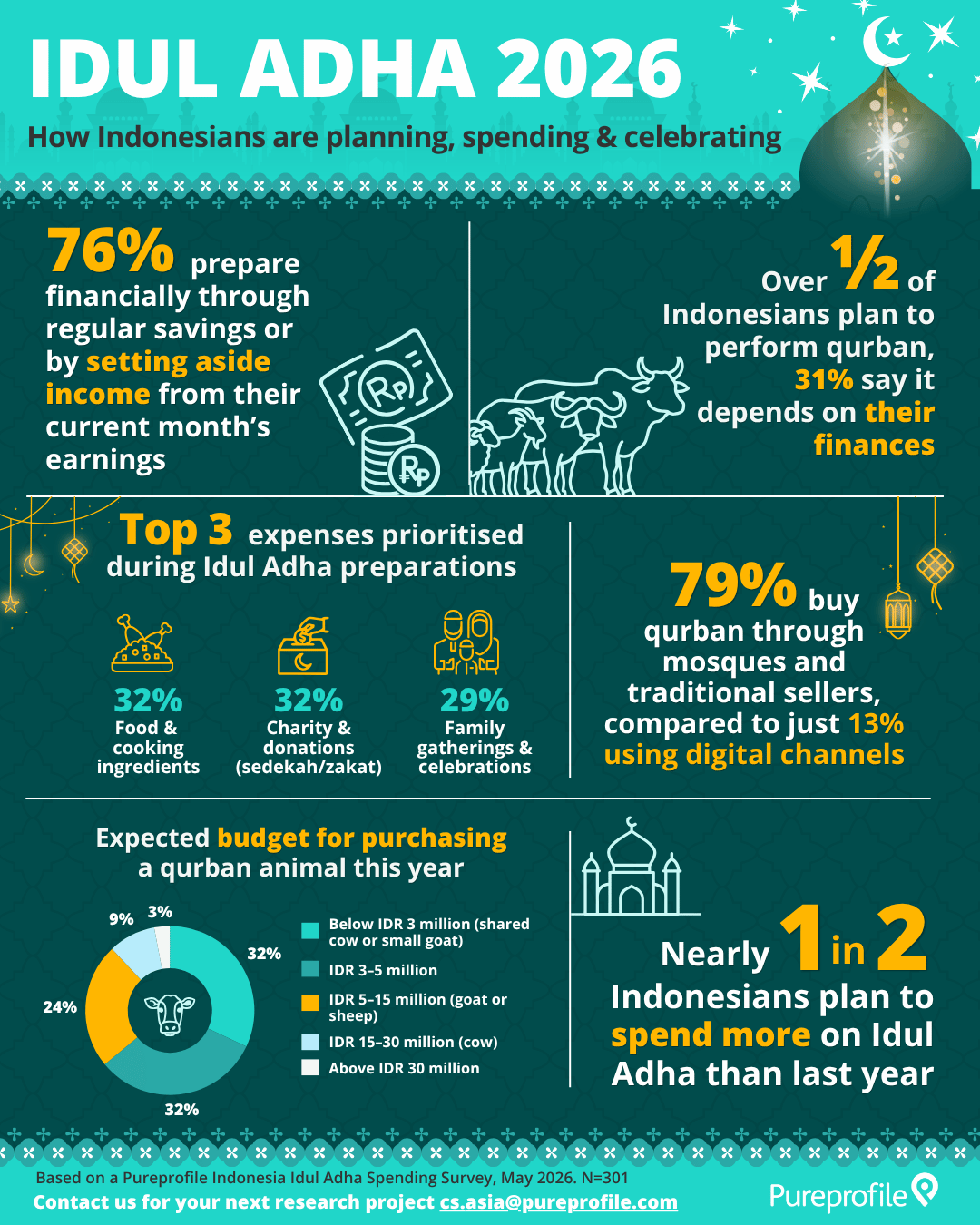
Based on a survey of 301 Indonesian respondents conducted in May 2026.