


As consumers consider the year ahead, new year priorities are influencing how people across both the UK and the US think about money, wellbeing and the months to come. The start of 2026 appears to be defined less by sweeping change and more by thoughtful planning, as households consider how best to approach the year within their financial means.
To explore these intentions in more detail, Pureprofile surveyed 1,011 consumers across the UK and 1,009 in the US, with both samples nationally representative. Here is what we learnt about their plans for the year ahead.
Saving sits at the heart of new year priorities
62% of consumers in the US say saving more money is their top priority for 2026, compared with 59% of consumers in the UK. This places financial security firmly at the centre of decision-making as the new year begins.
Alongside saving, reducing existing financial commitments is also front of mind. 30% of Americans say paying off debt or their mortgage faster is a priority, compared with 27% of consumers in the UK. The higher proportion in the US points to a stronger focus on reducing financial pressure, particularly as households look to regain control after a period of rising costs.
Together, these priorities point to a clear theme across both countries: Consumers in the UK and the US are entering the year with a shared emphasis on financial stability, whether through building savings, actively reducing debt, or a combination of both.
Health and wellbeing matter without higher spend
45% of Brits and 43% of Americans say improving health and fitness is a priority for 2026. In the US, this focus extends beyond physical health; 32% of Americans identify improving wellbeing as a key priority.
When looking at planned purchases for the new year, however, spending on fitness is notably lower. In the UK, only 15% of consumers plan to buy gym memberships or fitness-related products, placing it below categories such as household items (23%), fashion/apparel (21%) and technology/gadgets (21%), despite the high importance placed on health and fitness overall.
A similar pattern is evident in the US, where only 14% of Americans plan fitness or gym-related purchases, compared with household items or appliances (32%), fashion/apparel (31%), technology/gadgets (26%), and furniture or home improvement (25%). This gap suggests that while health and fitness are important goals, many consumers are approaching wellbeing in more cost-effective ways. Outdoor activities, home workouts or lifestyle changes may be taking priority over paid memberships, reflecting a more cost-conscious approach to wellbeing.
Travel plans reflect early budgeting
32% of UK consumers say travelling more is a priority for 2026, compared with 26% of consumers in the US. At the same time, early-year booking plans suggest people are thinking ahead. 22% of Brits and 19% of Americans plan to book flights or hotels in January and February, indicating that those intending to travel are budgeting early and securing plans in advance, with value and affordability in mind.
This reflects a practical approach to managing travel costs as part of wider financial planning. It also aligns with the broader theme of value-led planning seen throughout the data, where experiences remain important but are being managed carefully within personal budgets.
Practical home purchases lead early-year spending
When it comes to early-year purchases, practical needs take precedence in both countries. 32% of consumers in the US plan to buy household items or appliances early in the year, compared with 23% of consumers in the UK.
Alongside this, 1 in 4 Americans plan furniture and home improvement purchases in January and February. This highlights a strong focus on the home, particularly in the US, as consumers prioritise practical upgrades and longer-term value at the start of the new year. Viewed together, these trends reinforce the importance of domestic priorities in early 2026, with spending decisions shaped by considered decision-making around everyday needs rather than impulse buys.
Across the UK and the US, consumers are beginning 2026 with a clear sense of what they want to focus on. Financial security remains central, while health, travel and home improvements continue to shape practical early-year decisions.
Overall, the findings paint a picture of intention, balance and forward planning. Rather than cutting back entirely, people are thinking carefully about how they prioritise and pace their spending in the new year to feel prepared and focused on the things that matter most.
The infographic series below represents key findings from our research:
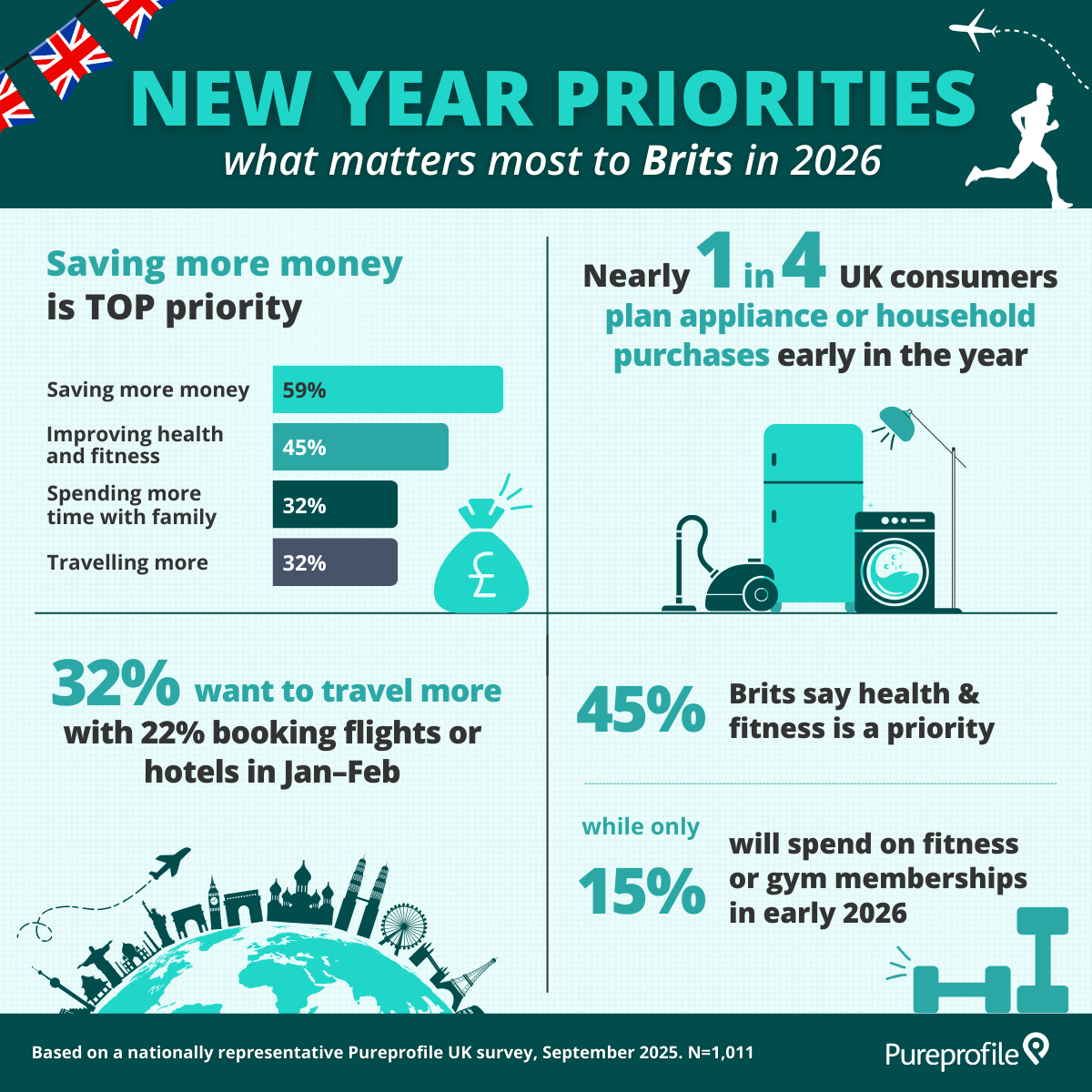
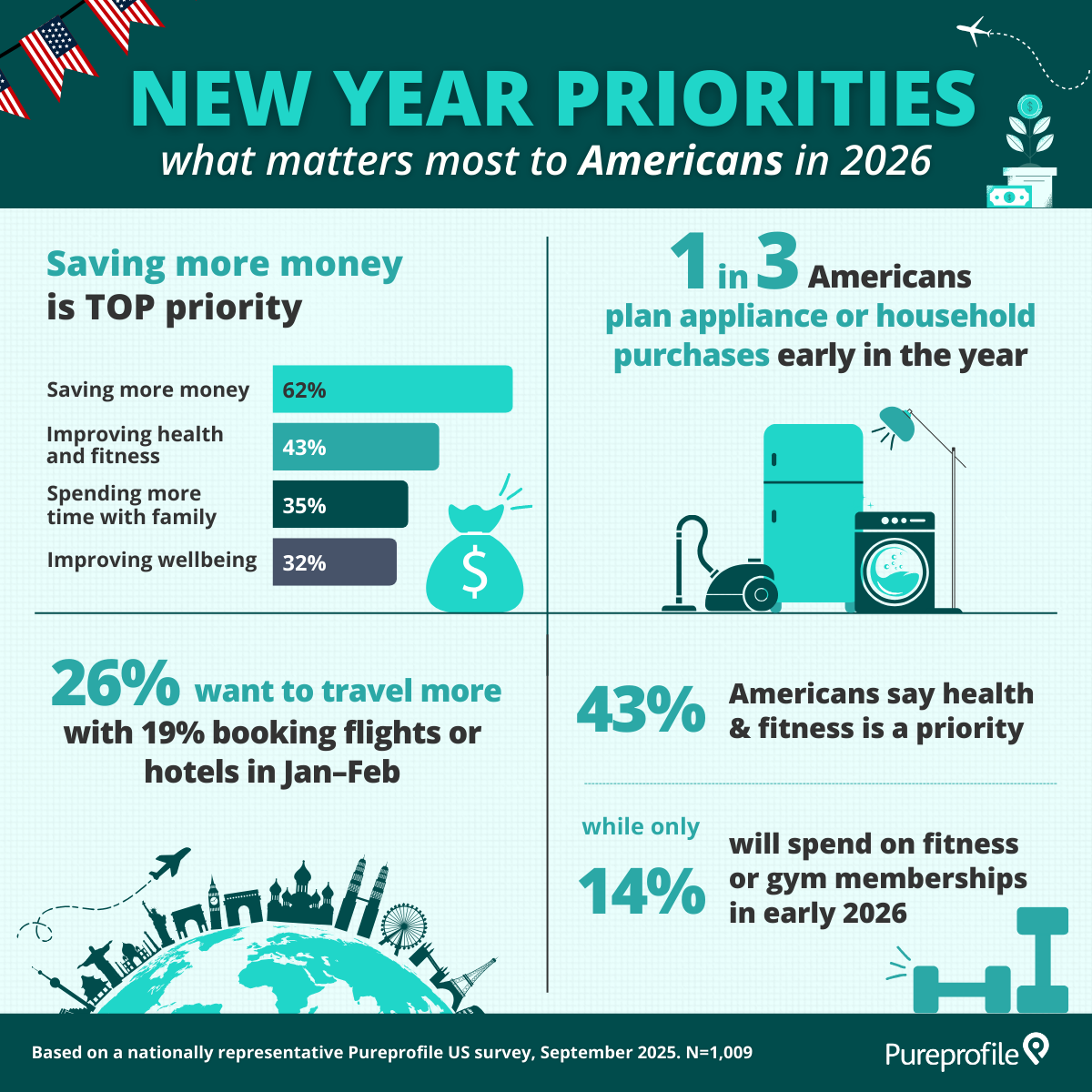
Based on a nationally representative Pureprofile survey of 1,011 people in the UK and 1,009 in the US, September 2025.
Share this infographic on your website