


By: Tyrone S’ng, Data and Solutions Lead
The debate over digital ID in the UK has intensified in recent weeks. What began as a government proposal to modernise identity verification and reduce fraud has quickly become a major point of public and political discussion. Ministers are now moving ahead with design and consultation stages, clarifying that digital ID will not be mandatory across all areas but will be required for certain checks such as employment and Right to Work.
At the same time, opposition has grown amid concerns about surveillance and data vulnerability. In response, the government has been defending its position, emphasising privacy protections and promising a design that ensures accessibility for people without smartphones. The debate has expanded from whether digital ID should exist to how it should be implemented, and how privacy can be protected in the process.
To understand how the British public viewed the proposal at the time of its announcement, and how those views fit within the wider conversation, we conducted a nationally representative survey (by age, gender, and country) of 1,000 UK adults combined with social and search trend analysis. The results reveal a nation caught between the promise of security and the fear of surveillance, with trust emerging as the single most important fault line.
Divided public opinion
When asked their position, 40% support digital ID in principle and 35% oppose it. An additional 15% are undecided, and 10% say they don’t know enough to decide.
A chi-square analysis shows these differences are statistically significant by age. Support is far higher among younger adults (18-34), while older groups (45+) are more likely to oppose or remain uncertain.
Public trust in the government’s rationale
When we asked respondents how much they trust in the government’s stated rationale for digital ID (claims that it will secure borders, reduce illegal work, prevent fraud, and make access to services easier), 44% expressed distrust, 39% said they trust the claims, and 17% were neutral.
The chi-square test shows age is again a major factor. An ANOVA test confirms this, and post-hoc results show that younger groups (18-34) have significantly higher trust scores than middle-aged and older groups (35-54 and 55+).
UK public views on digital ID
Responses to how much people agreed or disagreed with specific statements about digital ID painted a clear picture of a public weighing practical benefits against deep-seated concerns.
Just under half of respondents agreed that digital ID would help prevent fraud and identity theft (44%) or strengthen border security and reduce illegal working (42%). These potential benefits were overshadowed by more dominant fears. A majority (62%) believe digital ID would give the government too much power to monitor people, and 67% think it would put their personal data at risk of hacking or misuse. The single biggest worry was uncertainty about who would control their data (73%) – government or private companies.
Concerns about fairness also emerged: 55% agreed that digital ID could disadvantage certain communities, such as immigrants or those less familiar with technology.
Statistically, these perceptions vary meaningfully across age groups. ANOVA tests show significant differences in how generations view fraud prevention, border control, surveillance, and community disadvantage, while worries about data misuse are universal. Put simply, almost everyone fears data breaches. But older adults are far more likely to associate digital ID with surveillance and unfairness, while younger adults see its potential for streamlining access and reducing fraud.
What drives support and opposition
So what actually drives someone’s support or opposition to digital ID? To find out, we used hierarchical logistical regression to test whether people’s beliefs about digital ID still mattered once we accounted for their demographics. The answer: they matter a lot.
When these beliefs were added to the model, it explained over 50% more of the differences in support compared to demographics alone. In simple terms – people’s opinions about what digital ID will do are far more powerful than who they are.
The main reasons people support digital ID:
- It will help prevent fraud and identity theft
- It will strengthen border security
Together, these two beliefs are the strongest positive predictors of support. And they remain significant even after controlling for age, gender, and region.
The main reasons people oppose digital ID:
- Concerns that it will give the government too much power to monitor people
- Fears that personal data could be hacked or misused
Even after factoring in demographics, people’s attitudes toward security, privacy, and trust are what really shape how they feel about digital ID.
Supporters focus on protection, efficiency, and safety.
Opponents focus on privacy, power, and control.
How the online conversation mirrors the data
The same themes dominating the survey are echoed across the digital public sphere. Social and search analysis of the UK’s online discourse reveals that the conversation around digital ID is deeply polarised – split between those who see it as a step toward greater security and convenience, and those who fear it represents a loss of personal freedom.
Fears of government surveillance, loss of autonomy, and data control dominate social media discussions, mirroring the high levels of distrust captured in our survey. Much like our findings on public sentiment, the online conversation reflects a deep trust deficit – one fuelled by concerns about transparency, data rights, and government overreach.
Social analysis confirms that trust and transparency are at the heart of the debate. Discussions about digital ID frequently frame it as a risk to privacy and autonomy, which precisely mirrors our survey findings that 73% of respondents are concerned about who would manage and access their personal data. Viral petitions and conspiracy narratives reflect this trust vacuum, where a lack of clear information fuels suspicion and misinformation.
Search behaviour tells a similar story. The most common queries relate to data privacy, fraud risk, and who controls the system, while far fewer focus on potential benefits or convenience. Many of these searches are informational, such as What is digital ID? or Will digital ID be mandatory? – highlighting a persistent knowledge gap and an opportunity for policymakers to shape the narrative before opinions harden further.
Together, these online patterns reinforce what the survey reveals: Brits are not simply debating the technology of digital ID, but negotiating the boundaries between security and freedom, trust and control.
What does digital ID mean for the UK
The findings highlight a profound trust gap in how digital policy is communicated and perceived. Brits are not rejecting digital ID outright. In fact, a slim majority see practical benefits. But they are deeply uneasy about who controls their data, how it will be used, and whether it could expand government surveillance.
Building trust means acknowledging these anxieties transparently, communicating specific safeguards, and engaging citizens not just as users of the system, but as stakeholders in its governance.
The UK’s digital ID rollout faces not just a communications challenge, but a cultural one. Until trust in data governance is strengthened, support will remain cautious and conditional. Both public conversation and statistical evidence point to the same reality. Brits accept digital progress, but not at the expense of privacy and autonomy.
The infographic below represents key findings from our research:
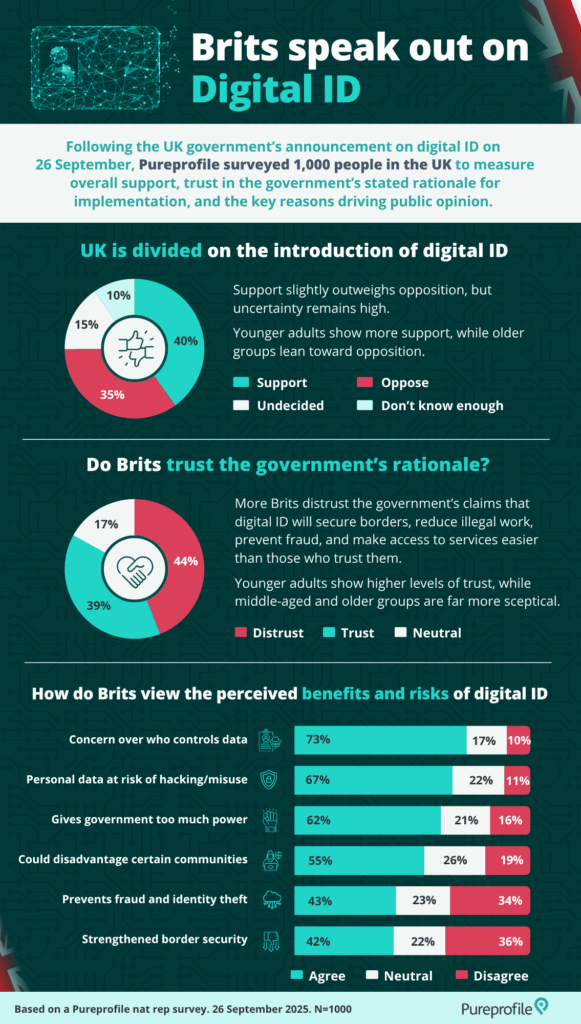
Based on a Pureprofile nationally representative survey of 1000 UK people, September 2025.
Share this infographic on your website

Tyrone S’ng
Data and Solutions Lead
With experience spanning Southeast Asia and the United Kingdom, Tyrone brings a global perspective to his role as Data and Solutions Lead. Tyrone serves as a trusted advisor for the Data & Insights team, translating complex client needs into actionable, data-driven solutions and supporting internal teams to ensure optimal project delivery.
In addition to his professional practice, Tyrone served as an Adjunct Lecturer at Temasek Polytechnic, where he taught Research Methods for the Specialist Diploma in Applied Psychology (Behavioural Insights). This dual engagement in both academia and industry positions him to bridge rigorous research standards with practical, client-focused insights.