


Since December, Australia’s under-16s social media ban has marked a major shift in the national conversation around online safety, platform accountability, and the digital lives of young people.
While the ban aims to reduce risk and protect children online, new Pureprofile research suggests an important challenge remains:
Parents may not fully understand what children are doing online in the first place.
Our 2025 research, conducted before the ban took effect, highlights a growing disconnect between what parents believe their children are accessing and how children report engaging with social platforms, messaging features, and online content.
As restrictions come into effect, this awareness gap becomes increasingly important – because if risky behaviour continues through workarounds or alternative platforms, it may simply move further out of view.
Who we surveyed – and why it matters
The full study explored attitudes and behaviours across the full ecosystem surrounding children’s digital lives.
We surveyed:
- Parents of children aged 8–15
- Children aged 8–15 (assisted by parents)
- Primary and secondary school teachers
- Adolescents aged 16–24
While this infographic focuses specifically on the gap between parents’ perceptions and children’s reported behaviour, the full report also captures perspectives from teachers and young people – offering a broader view of how different groups experience, interpret, and respond to the ban.
Parents know the devices – but not the digital reality
Many parents feel confident they know which devices their children use, and may even have rules in place around screen time or app access.
However, when it comes to actual online behaviour, children consistently report higher engagement across major platforms than parents realise.
This gap is most evident in two areas: messaging behaviour and platform usage.
Messaging strangers remains a significant blind spot
One of the most concerning findings relates to private messaging features.
Nearly half (46%) of 13–15 year olds report using messaging tools to speak with strangers online.
By comparison, only 39% of parents believe their child does.
This difference highlights how easily risky interactions can occur through chat functions embedded in social media platforms, gaming environments, and video apps – often without adult awareness.
Platform use is higher than parents think
The research also shows that parents frequently underestimate how widely children are using major platforms.
For example:
- 66% of children aged 8–15 report using YouTube
- Yet only 40% of parents believe their child does
While YouTube is often viewed as a mainstream or lower-risk platform, it remains one of the most significant parts of children’s digital ecosystems – and may expose young users to content and interactions that parents are not fully aware of.
Parents don’t always know what kids can access
Perhaps most telling is the level of uncertainty parents themselves report.
Over 1 in 3 parents (38%) of children aged 8–12 admit they don’t know what their child can access online.
This points to a broader issue: the speed at which platforms evolve, combined with the rise of private messaging and algorithm-driven content, can make parental oversight increasingly difficult.
Children report higher use across major platforms
Beyond YouTube, children aged 8-15 report much higher usage of key social and messaging platforms than parents realise, including:
- TikTok (35% of kids vs 20% of parents)
- Snapchat (29% of kids vs 17% of parents)
- WhatsApp (30% of kids vs 18% of parents)
These gaps suggest children’s online engagement is often broader and more socially connected than parents expect – particularly as they enter their teenage years.
Why this matters now that the ban is in place
With Australia’s under-16s social media ban now in effect, these findings raise an important consideration:
If children can still access platforms through workarounds, shared accounts, or alternative apps, risky behaviour may not disappear – it may simply shift further away from parental oversight.
Policy is an important step, but the data shows that safety outcomes will also depend on awareness, communication, and the ability of parents, educators, and platforms to respond to how children actually behave online.
Closing the awareness gap
Protecting young people online requires more than restrictions alone. It also requires:
- Greater parental understanding of platform features
- More open conversations between parents and children
- Increased transparency and responsibility from platforms
- Continued research into youth digital behaviour under new regulations
As Australia enters this new regulatory environment, understanding the reality of children’s online lives will be critical.
Download the full report
Pureprofile’s full findings explore how parents, children, teachers, and young people differ in their perceptions of platform use, messaging behaviour, online risk, and the effectiveness of the under-16s social media ban.
Download the full Australia’s under-16s social media ban report here >
The infographic below represents key findings from our research:
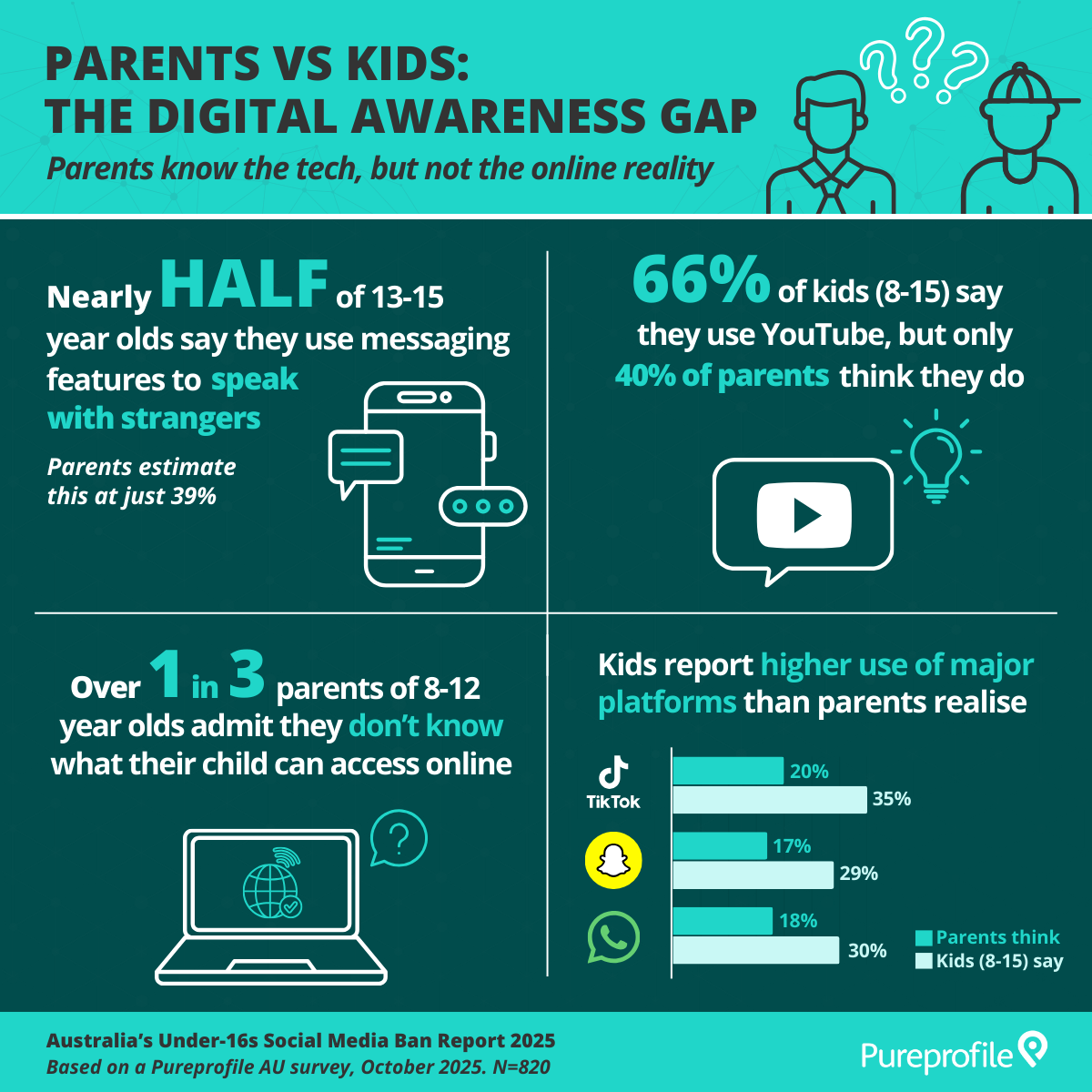
Based on a Pureprofile survey of 820 people in Australia, October 2025.