


By: Tyrone S’ng, Data and Solutions Lead
England’s local elections offered more than a snapshot of political performance. They revealed how voters are balancing everyday pressures, expectations of local government and wider national frustrations when making decisions at the ballot box.
Ahead of the May 2026 vote, Pureprofile surveyed 1,011 adults in England to understand the issues shaping local election behaviour. Looking back at the results, the findings help explain the mindset behind local voting decisions and the growing pressure on councils and candidates to demonstrate they can deliver meaningful improvements to local services and community outcomes. From the cost of living and GP access to accountability for local services and candidate credibility, the research shows that local elections are increasingly influenced by both community-level concerns and broader economic realities.
Everyday pressures influenced local votes
The research highlights how voters approached local elections through the lens of daily life. These are the key issues that influenced local voting decisions:
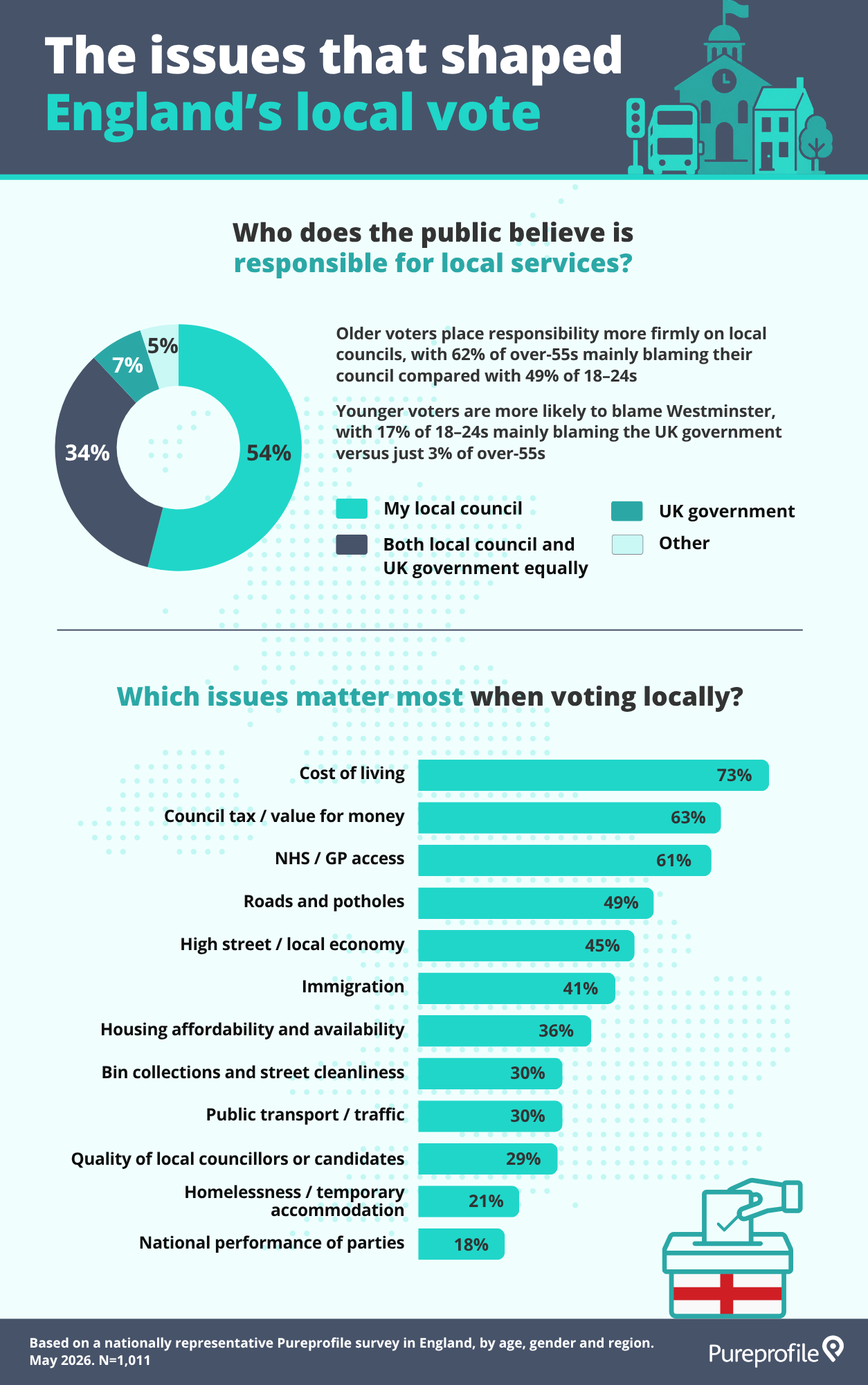
- Cost of living (73%)
- Council tax and value for money (63%)
- NHS and GP access (61%)
- Roads and potholes (49%)
- High street and local economy (45%)
While local elections traditionally focus on community services and council performance, the findings suggest national economic pressures are increasingly being experienced and evaluated at a local community level. Household finances, pressure on public services and visible infrastructure issues are shaping how people assess local leadership.
Housing affordability and availability also remained important for more than a third of respondents (36%), while immigration (41%) continued to feature prominently in voter priorities.
National performance of political parties ranked far lower at 18%, indicating that while national sentiment still influences voters, many are ultimately focused on practical outcomes closer to home.
Voters expect local accountability
When we consider how voters assign responsibility for local services, the findings show councils remain the main body voters associated with delivering outcomes within their communities.
54% of respondents say local councils are mainly responsible for local services, while 34% believe responsibility is shared equally between councils and the UK government.
However, attitudes varied significantly by age. Older voters are more likely to place responsibility directly on councils, with 62% of over-55s mainly blaming their local authority compared with 49% of 18-24s. Younger voters, meanwhile, are more likely to point towards Westminster, with 17% of 18-24s mainly blaming the UK government versus just 3% of over-55s.
The results suggest voters understand the complexity of local governance but still expect councils to deliver tangible improvements in their communities.
Local voters prioritise credibility and community understanding
When deciding between local candidates or parties, voters placed greater emphasis on community understanding and the ability to deliver effective local leadership than on national political figures.
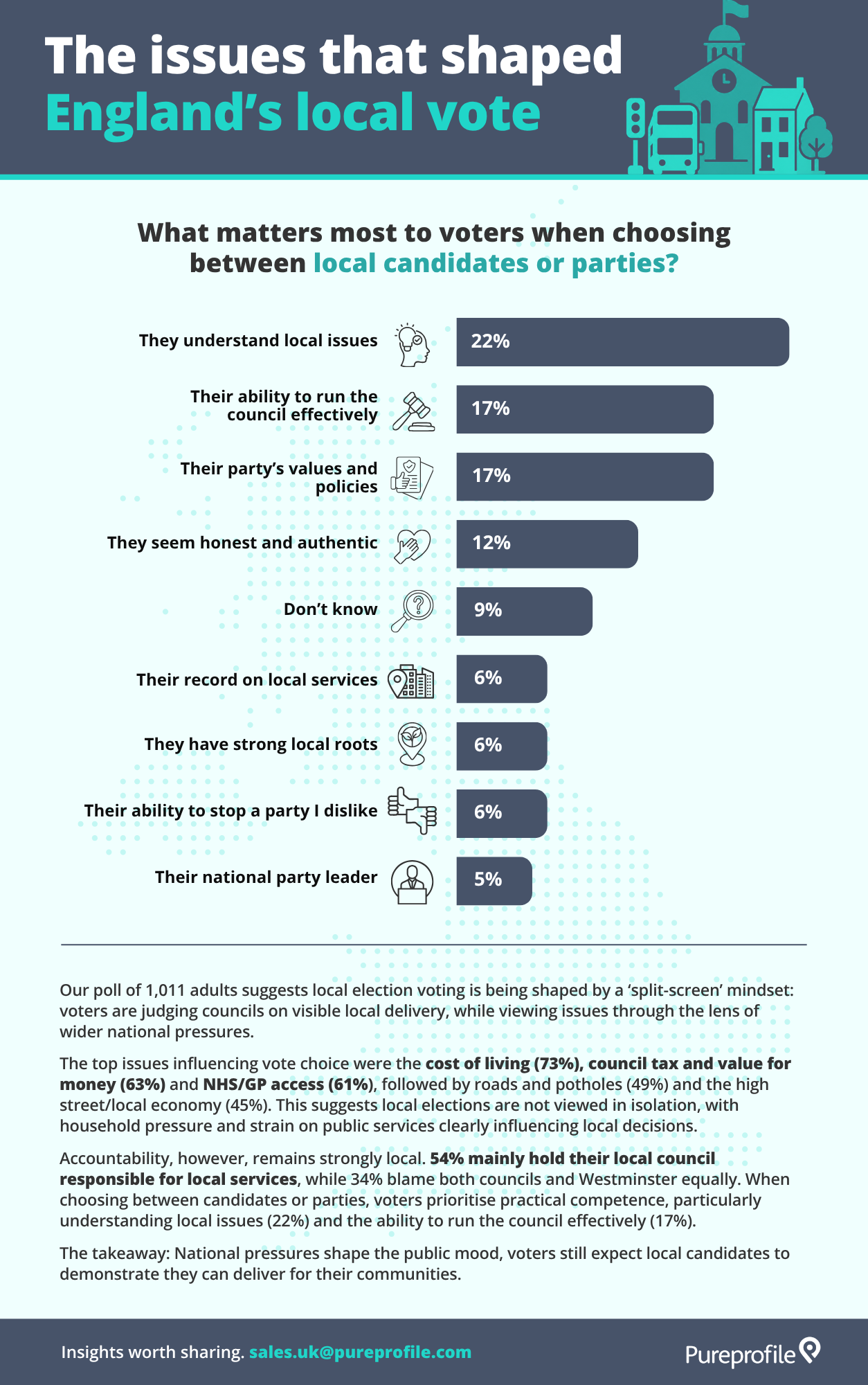
22% of respondents said understanding local issues was the most important factor when choosing between candidates or parties. 17% prioritised a candidate’s ability to run the council effectively, while another 17% focused on party values and policies.
Honesty and authenticity in a local candidate or party matters, selected by 12% of respondents. In comparison, only 5% said a candidate’s national party leader was their main consideration when voting locally. The findings reinforce the idea that local elections are increasingly shaped by expectations around visible community impact, local knowledge and confidence in a candidate’s ability to respond to the issues affecting residents day to day, rather than national political identity alone.
For councils, candidates and political parties, the message is clear. Voters expect local representatives to understand community pressures, demonstrate competence and show they can deliver meaningful change where it matters most.
As England reflects on the outcome of the 2026 local elections, the research suggests voters are weighing national pressures alongside expectations of local delivery and accountability. Visible action and confidence in local leadership remain central to earning trust at the ballot box.
The infographic series below represents key findings from our research:
Based on a nationally representative Pureprofile survey of 1,011 people in England, May 2026.
Share this infographic on your website

Tyrone S’ng
Data and Solutions Lead
With experience spanning Southeast Asia and the United Kingdom, Tyrone brings a global perspective to his role as Data and Solutions Lead. Tyrone serves as a trusted advisor for the Data & Insights team, translating complex client needs into actionable, data-driven solutions and supporting internal teams to ensure optimal project delivery.
In addition to his professional practice, Tyrone served as an Adjunct Lecturer at Temasek Polytechnic, where he taught Research Methods for the Specialist Diploma in Applied Psychology (Behavioural Insights). This dual engagement in both academia and industry positions him to bridge rigorous research standards with practical, client-focused insights.