By: Tyrone S’ng, Data and Solutions Lead
With a new Prime Minister and Chancellor at the helm, the UK Budget 2026 comes at a pivotal moment for the Labour government. As new measures aimed at easing household financial pressures are announced, which proposals are most likely to win public support? Beyond the UK Budget itself, the changing political landscape also raises questions about public mood, perceptions of government performance and whether Labour is rebuilding support among its previous voters.
Our latest UK Budget study surveyed 1,091 UK adults, with a sample nationally representative by age, gender and region. Compared with our 2025 UK Budget research, the findings reveal where Labour is gaining ground and where the public still needs convincing.
Public expectations of the UK Budget improve
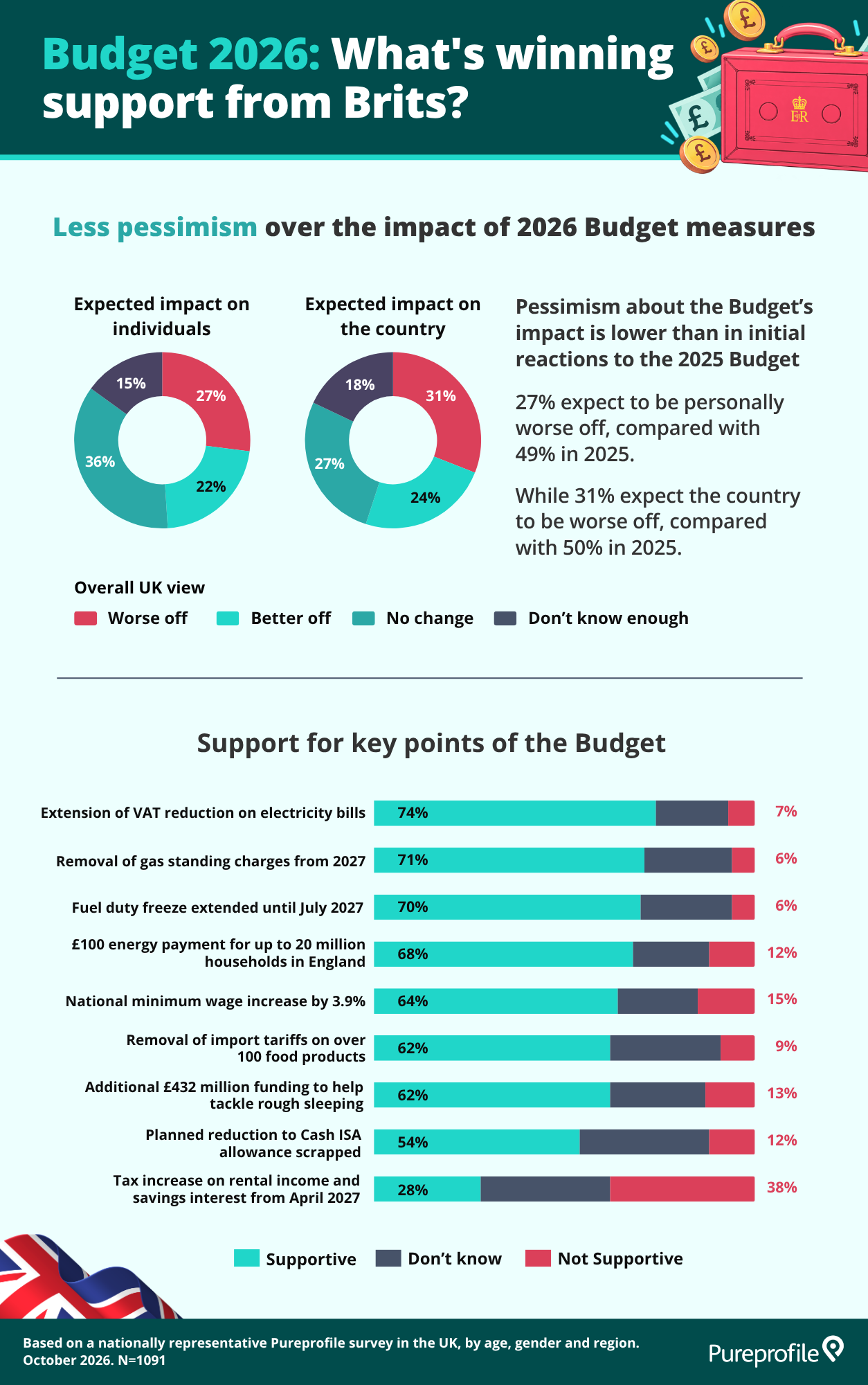
Public expectations of the Budget’s impact are less negative than in initial reactions to last year’s announcement. 27% of Brits expect to be personally worse off, down from 49% in 2025. For the country, that figure is 31%, compared with 50%.
Alongside this sharp fall in pessimism, the proportion expecting no personal change has also increased. 36% of Brits expect to be neither better nor worse off, up from 24% in 2025. Just 22% expect to be personally better off. The public is less pessimistic, but widespread expectations of improvement have yet to emerge.
The proportion of Brits expecting to be personally better off has increased across all three age groups, although the age divide persists:
- 18–34 years: 41%, up from 33% in 2025
- 35–54 years: 20%, up from 13% in 2025
- 55–years and over: 9%, up from 3% in 2025
All three increases are statistically significant. Younger adults remain more likely to see a personal benefit from the measures. This could create an opportunity for Labour to strengthen its appeal to them, although our results do not establish whether those expectations translate into votes.
Several UK Budget measures attract strong support, with the following proposals proving most popular among Brits:
- 74% support extending the VAT reduction on electricity bills
- 71% support removing gas standing charges
- 70% support extending the fuel duty freeze
The proposed tax increase on rental income and savings interest received a less favourable response, with 38% opposed compared with just 28% in support.
Labour’s performance ratings improve, but doubts remain
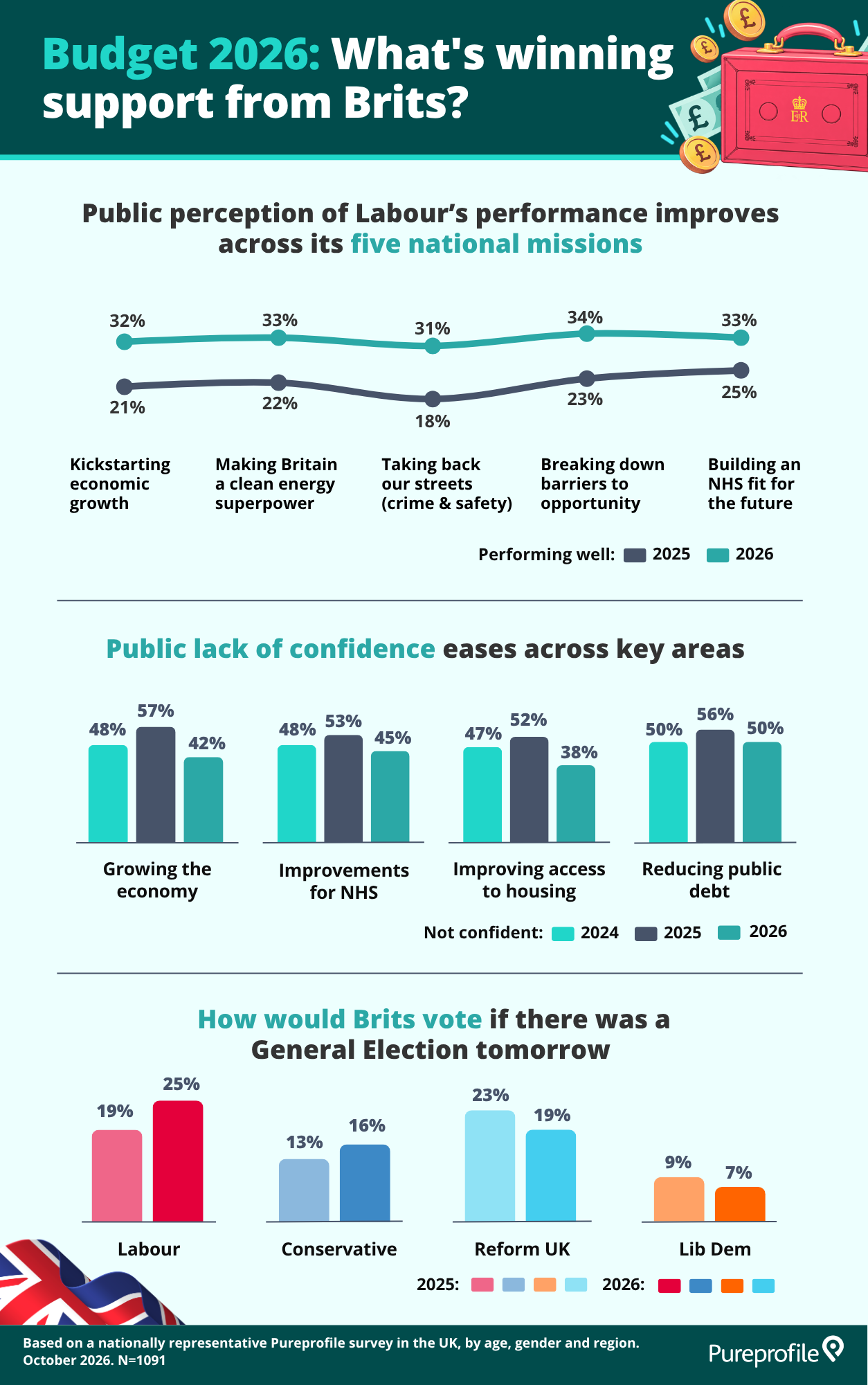
Pureprofile’s UK Budget survey reveals how Brits rate Labour’s performance across its five national missions. The share rating the government as performing well has increased significantly across all five areas, with notable improvements in:
- Crime and safety: 31%, up from 18% in 2025
- Economic growth: 32%, up from 21% in 2025
- Building an NHS fit for the future: 33%, up from 25% in 2025
Confidence in future delivery also improves, particularly for economic growth and housing. The proportion confident that Labour will grow the economy rises from 21% in 2025 to 28% in 2026, while confidence in improving access to housing increases from 23% to 31%. Both increases are statistically significant.
However, concerns remain. 50% of Brits are not confident that Labour will reduce public debt, compared with 22% who are confident (2% up from 2025). Similarly, 45% of Brits are not confident that Labour will reduce NHS waiting times and improve quality, compared with 27% who are confident. Across all four delivery measures, those lacking confidence still outnumber those expressing confidence.
UK voting intentions point to a partial Labour recovery
Across the full sample, Labour’s voting intention rises significantly from 19% in 2025 to 25% in 2026. Reform UK stands at 19%, down from 23% last year, reversing the positions of the two parties in our findings.
Looking more closely at previous voters, Reform UK’s retention falls from 91% to 76%, also a statistically significant change. Conservative retention increases from 64% in 2025 to 69%, while Green retention falls from 76% to 73%. Liberal Democrat retention rises from 56% to 71%, although these latter three differences do not remain statistically significant after adjusting for multiple comparisons.
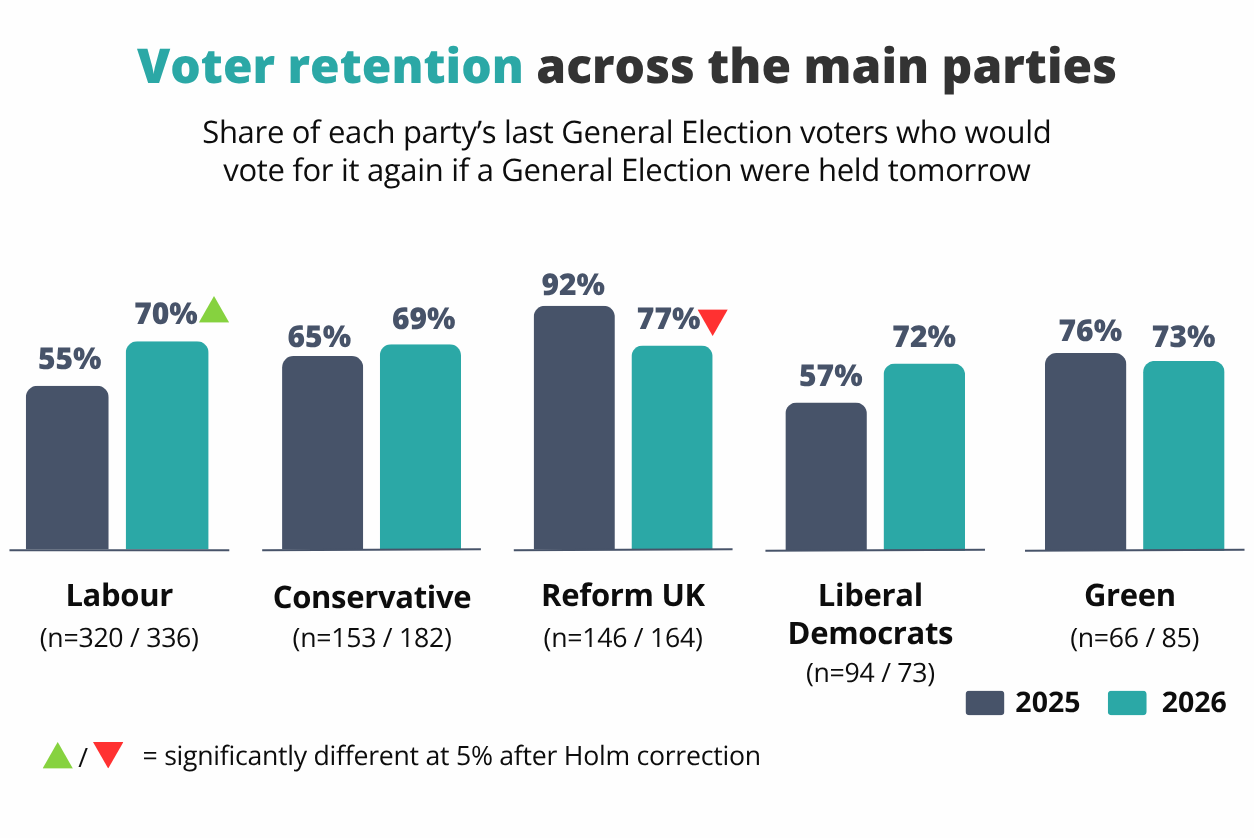
Looking more closely at Labour’s voter retention, 70% of those who voted Labour at the last General Election say they would vote Labour again if an election were held tomorrow. This compares with 55% in our 2025 study, a statistically significant increase of 15 percentage points and one of the clearest signs of renewed momentum in the research.
Labour’s recovery nevertheless remains partial. Its current voting intention remains below the 31% in our 2026 sample who recall voting Labour at the last General Election. It is important to note that our independent annual surveys do not track individual voters over time, nor do they establish that the Budget caused these changes.
The public response gives Labour grounds for encouragement. Expectations of the UK Budget’s impact are less negative than last year, with measures aimed at easing household costs attracting strong support. Improved government performance ratings and stronger loyalty among previous Labour voters also suggest a more favourable public mood. However, substantial doubts about Labour’s ability to deliver remain, suggesting that improving sentiment has yet to become widespread confidence.
The infographic series below represents key findings from our research:
Based on a nationally representative Pureprofile survey of 1,091 people in the UK, October 2026.
Share this infographic on your website

Tyrone S’ng
Data and Solutions Lead
With experience spanning Southeast Asia and the United Kingdom, Tyrone brings a global perspective to his role as Data and Solutions Lead. Tyrone serves as a trusted advisor for the Data & Insights team, translating complex client needs into actionable, data-driven solutions and supporting internal teams to ensure optimal project delivery.
In addition to his professional practice, Tyrone served as an Adjunct Lecturer at Temasek Polytechnic, where he taught Research Methods for the Specialist Diploma in Applied Psychology (Behavioural Insights). This dual engagement in both academia and industry positions him to bridge rigorous research standards with practical, client-focused insights.